🌌 The Solar System
Eight planets, one star, and a great many rocks that have not hit us yet. Everything below is computed from real orbital mechanics — nothing here is decorative.
🔭 Where everything is, right now
Positions come from JPL's Keplerian elements for the planets, solved for the date shown — accurate to about an arcminute, which is finer than a pixel here. Each planet's direction from the Sun is exact. Inner draws the first four to true scale. All 8 squashes distance by a square root, because Neptune orbits 78× further out than Mercury and a truthful linear drawing would bury the inner four inside the Sun. Planet sizes are not to scale in either view, or Jupiter would be a full stop and Mercury invisible. Drag the date, or press play and watch the inner planets lap the outer ones.
📸 NASA's Picture of the Day
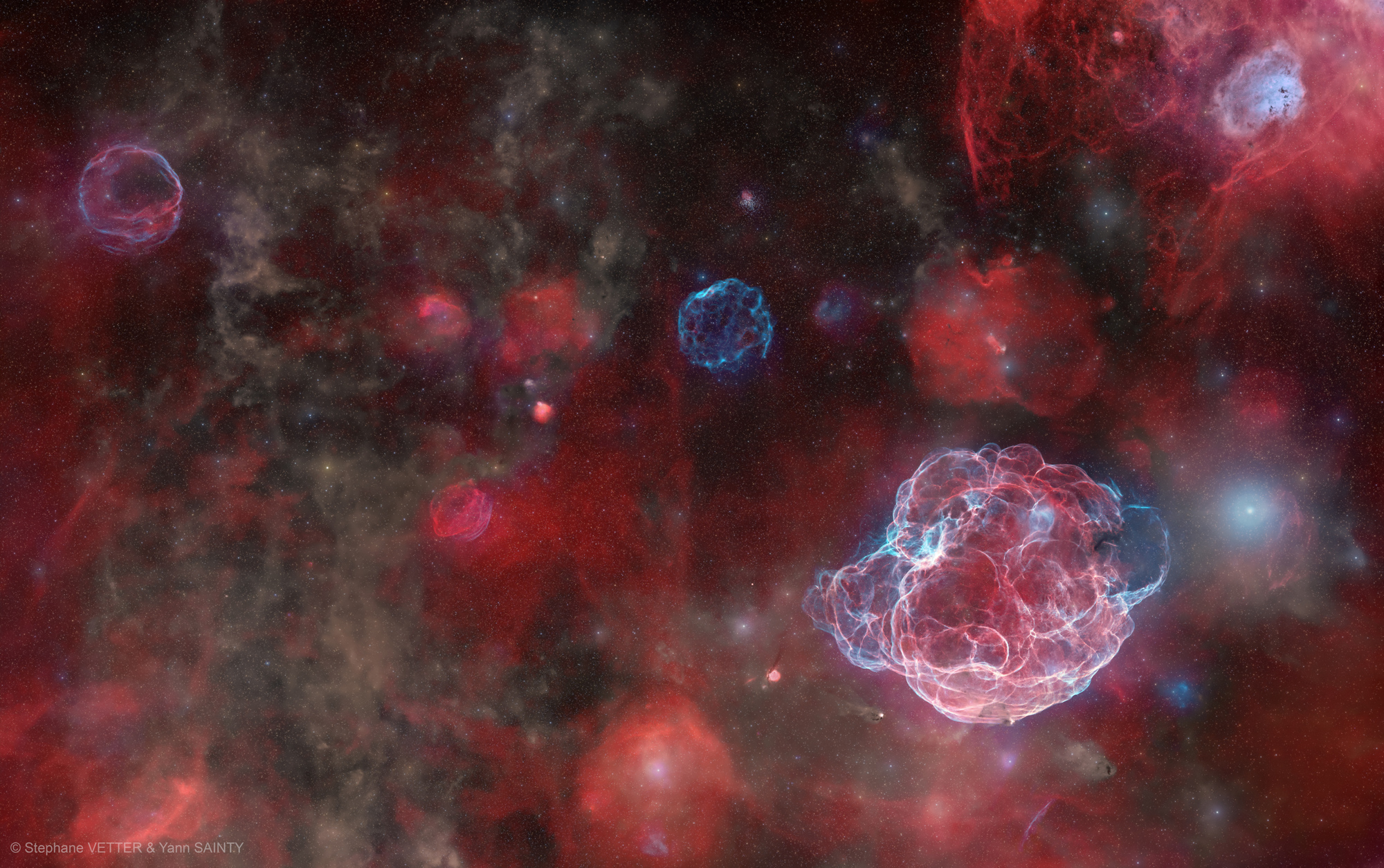
The Ghosts of Five Supernovas
The ghosts of five supernovas haunt this extraordinary image. It was acquired at Oukaïmeden Observatory in Morocco with approximately 200 hours of observations and shows a large patch of the sky, equivalent to the area of one thousand full moons tiled together, in the constellation of Auriga (the charioteer). From left to right, the five supernova remnants visible across the field are G181.1+9.5, G182.4+4.3, G179.0+2.6, G180.0−1.7 (Sh2-240, the Spaghetti Nebula), and G178.2−4.2. They are highlighted in the annotated image, together with open cluster M37 and the Tadpole Nebula. As each explosion expanded into space, it created a growing shell of shocked gas and delicate filamentary structures shown in red (hydrogen) and blue (oxygen), respectively. These ancient stellar explosions happened independently; they are at various distances up to about several thousands of light-years away from Earth and have estimated ages up to tens of thousands of years old. Early humans may have witnessed them as bright new stars, fading over weeks or months. APOD's email for image submissions has changed. Please see: APOD Submissions. APOD's main NASA site is moving : From apod.nasa.gov to science.nasa.gov/apod
Image credit: Stephane Vetter, Yann Sainty Text: Cecilia Chirenti (NASA GSFC, UMCP, CRESST II) · See it on NASA APOD · A new one every day, courtesy of NASA. Free, and better than anything we could take ourselves.
🪐 The planets tonight
Elongation is the angle between a planet and the Sun. Below about 15° a planet is lost in the glare no matter how bright it is — which is why a brilliant Venus can still be impossible to see. Altitude is measured at its best moment tonight; anything under about 10° is fighting haze and rooftops.
✨ Constellations overhead tonight
Computed for your latitude and the current date, sampled through the dark hours. Southern constellations simply never rise from far north, and the reverse — which is why this list looks completely different in Sydney than in Stockholm.
☄ The asteroid threat board
Torino scale runs 0 to 10 and is the headline number: 0 means no hazard, 8 or above means a certain collision. Palermo scale is the specialists' measure — it compares an object's risk against the odds of a similar impact happening anyway over the same period. Negative means less likely than the background rate; below −2 means the risk is trivial. Every object NASA currently tracks sits at Torino 0. These lists exist precisely so that anything genuinely dangerous would be spotted decades out.
Planet positions computed in your browser from JPL approximate ephemerides. Asteroid data from NASA/JPL Sentry and the close-approach database. More sky: Solar Outbreak Watch · Golden Hour & Night Sky · Global Hazard Watch